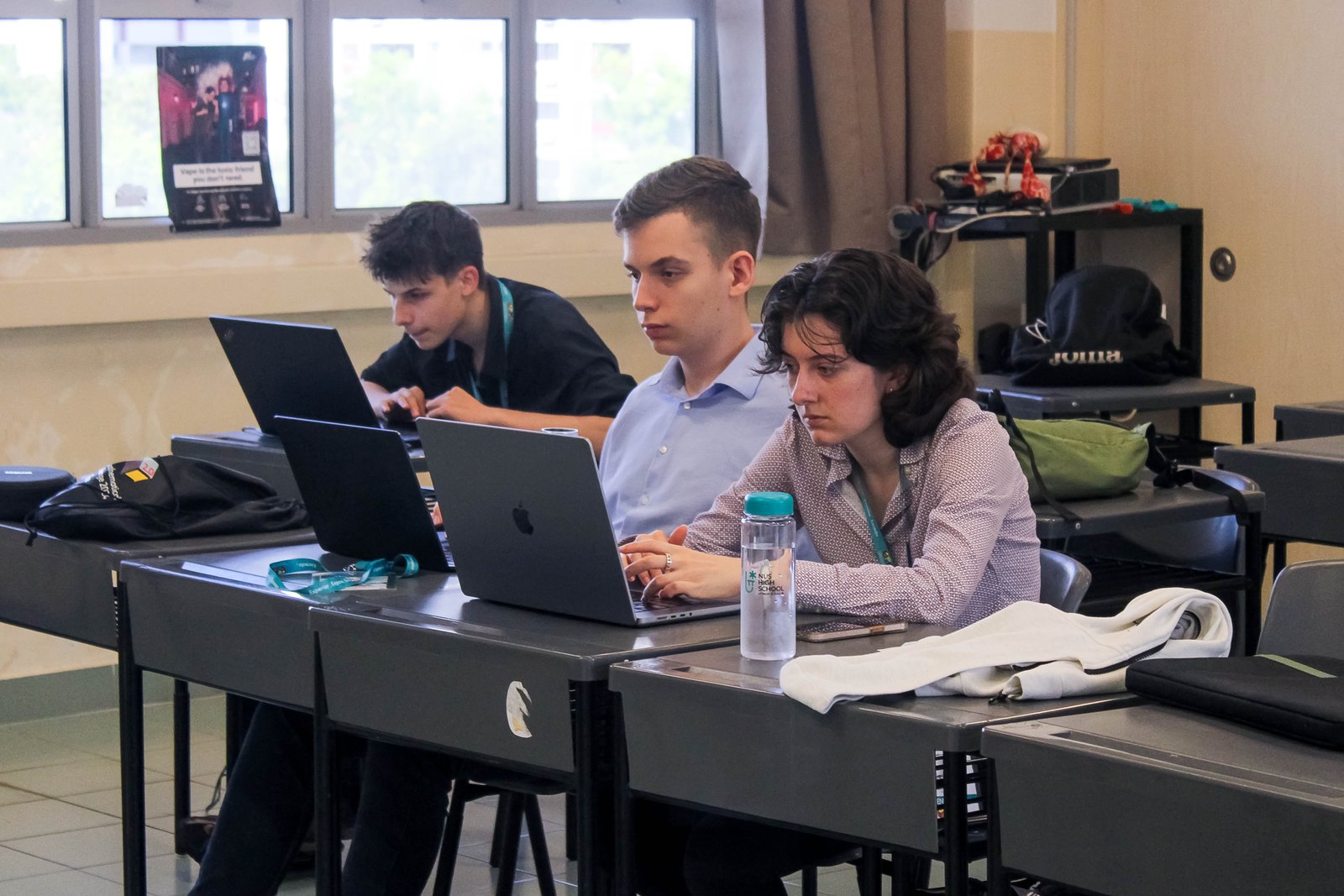
As the 3pm deadline for the written report loomed over their heads, the participants worked furiously to perfect their solutions.
Snug in their homes, our writers were also typing away diligently, though their stakes were perhaps much lower… With no other events to report on, we got our creative juices flowing.
To help you unwind, we have a variety of engaging pieces, from an interview with NUS High alumnus and current teacher Mr Caleb Koh to a poem about struggling with mathematics. You might also enjoy this short narrative that expresses the possible thoughts and feelings of an SIMC2.0 participant, or perhaps this opinion editorial on why AI may not be as threatening as it appears.
Lastly, here’s a throwback to Monday’s AI Learning Festival, featuring more interviews with the Explore track students.
A Day in the Life of a Teacher at SIMC
by Chang Yi Xuan Giselle and Tyra Peh

Most NUS High students know and admire Mr. Caleb Koh. He studied at NUS High three years ago. The 2021 batch’s Valedictorian, he is now a beloved Biology teacher (entering university soon). Now, he is back at SIMC after many years, helping to chaperone students. Why don’t we learn more about his experiences at SIMC?
Question: So, Mr Koh, what do you think of SIMC so far?
Mr. Koh: I think SIMC is going great! The student participants and their student programs liaisons (SPL) have been interacting with lots of enthusiasm and excitement. I was also really amused by the throwing of the SIMC paper cubes, and the dancing cube mascots! The posters in the hall by the students on the Explore track showed not just their research but also the many possibilities of the uses of AI. I believe that those on the Endeavour track are also excited for the release of the challenge.
Question: That is great to hear! After seeing some of the students, do you think that there is anything that makes their schools unique?
Mr. Koh: I think the culture for international schools! I had seen some students dressed in their ethnic costumes. Ultimately, the students and teachers are what make the schools unique too. I believe that they are also excited to learn more about our school and country, just as our students are also excited to learn more about the participants’ school and country!
Question: Well, how has your schedule been like for SIMC?
Mr. Koh: So far, I am only involved on Monday and Thursday! And yes, I am involved from 7:30am to as late as 9:30pm (for the cultural learning journey on Thursday). Naturally, as I stay in Tampines, I [must] wake up at about 5:15am to reach school at around 7am, and assuming there’s good traffic, I should reach home by 10:45pm on Thursday.
Question: Did you have any experience working in SIMC when you were a NUS High student?
Mr. Koh: Sadly, I did not. I was only involved when I was in Year 1 (2016), [when] NUS High held both ISSF (International Students’ Science Fair) and SIMC. I was in the Chinese Orchestra, and we performed during the opening ceremony! As it was one of my first few performances, I was honestly [very] nervous. … I was [just] glad that I got this chance to help [out] in SIMC!
Question: How was your experience with the SIMC participants this year?
Mr. Koh: I have not really interacted much with the participants, given that for Day 1 they were mostly with their SPLs. Regardless, I am quite excited for tomorrow’s cultural learning journey.
Thank you so much for all your responses, Mr Koh!
It is safe to say that Mr Koh is enjoying his duty at SIMC. His insights were indeed eye-opening, and we hope that you have gained a better understanding of a day in the life of a teacher helping in SIMC! It seems that Mr. Koh has adapted well to the long hours of SIMC, embracing the flow of activities with ease. We wish him and all the students who are working hard for SIMC a good rest in preparation for tomorrow’s activities.

I Dream of Magic Squares
by Renee Yeap Yew Jin
Does anyone know the joke
About the Parker square?
Wikipedia says it’s popular in mathematical culture
I wouldn’t know — I was never a mathematician.
I mean, I tried to be,
Watching maths videos, in confused understanding.
Daydreaming, I stare blankly at the screen — a visible reminder
Of invisible galaxies of numbers
That make a computer’s heart beat
I dream of numbers
Tripping over each other, getting their lines tangled
Twisting themselves together into knots
I think I have a knot in my brain.
It’s blocking my neurons and rerouting my thoughts
I mean, it’s just numbers
Right? All I need to do is use the formulas,
Press the taunting calculator — And there! My answers
But the way through the forest eludes me, I rub my eyes
But the map still looks blurry.
I think I’m dehydrated.
When did I last drink water? Maybe I need to
Take a break, look at the problem anew
Tomorrow, I will find the key, find the path
Somewhere, somewhere
The magic square will bless me
Unveil her secrets, clear the skies
One day — I will declare myself a mathematician
If only I search hard enough, my pilgrimage will extract
The mathematical nectar of the universe
Somewhere, everywhere

Source: https://en.wikipedia.org/wiki/Magic_square
Green Fact of the Day!
A set of reusable cutleries was given to each participant to encourage everyone to cut down on single-use plastics. Remember to wash them and bring them for your meals!
The Tortured Mathematicians Department
by Ridhi Sulaksh
Dark storm clouds swirled ominously outside, a perfect reflection of my internal emotional tumult. The atmosphere somehow seemed to dim even further as I stepped into the hall, a million eyes boring into me like beady spotlights. Grasping the chalk, a swirl of formulae and variables flooded my mind, and I stumbled back, the beginning of a migraine threatening to strike.
“He can’t do it!”
“Why’s he even here if he can’t solve a simple math problem?”
“Does he even have any friends?”
A cacophony of voices resounded in my ears, only intensifying when I slammed my hands over them, face scrunching up in a grimace. It was then that I dared to look up.
The silhouettes had grown taller, looming over me and creating an echo chamber of insults. My feet suddenly went limp as the ground fell beneath me, the wooden tiles giving way to nothingness.
And they watched me. The other students who were better and smarter and more sociable watched me as I fell, fell, fell.
I missed my friends. I missed my school. I missed my mother’s cooking.
I missed my home.
I closed my eyes, bracing for impact.
And then I opened them.
“Hey, hey”. A tap on my shoulder. I turned around, scratching at my slightly itchy navy-blue suit. A girl stared back at me, decked out in her school uniform, her blond hair neatly woven into twin braids which sat placidly atop her shoulders. She beckoned for me to come closer, cupping her hands over my ear so nobody else could hear.
“Recycling bin.”
As she pulled away, I nodded, turning to face my group’s Student Program Liaison.
“What was the phrase?” he asked, eyes squinting with his small smile.
“Recycling bin,” I mumbled, and the SPL replied, “Not quite, but you were close! The phrase was SIMC 2.0.”
How that was even remotely close to “recycling bin” was beyond me. I’d failed, I’d failed, I couldn’t even get a phrase right, how was I going to help my school win, I was going to embarrass them.
Everyone was watching me intently, but differently from the silhouettes in my nightmare. Their smiles were genuine, instead of them baring their teeth like a pack of lions ready to dig into their next meal.
We all broke out into laughter.
Looking around, seeing so many students from all over the world like me coming together, united by math and computing… I felt more confident.
Sure, I was far from home, but maybe it wouldn’t be so bad. Everyone had been nothing but welcoming, and I wondered if we could exchange numbers to keep in touch after the competition ended. Win or lose, the competition was all about…
having a blast with my team!

This is a creative recount that expresses a probable point-of view of SIMC2.0 participants, based on a composite of the responses that the writer received from interviews with the participants.
Why AI Won’t Replace Us: The Surprising Truth
by Patricia Adele Tham Yu Jin

“It is not AI that will replace those who don’t know how to use it, but the people who do know how to utilise AI.” — Dr Lee Chan Lye, NUS High School teacher
At SIMC’s Educators’ Learning Festival, a series of talks organised by educators from around the world, there was a lot of buzz on Artificial Intelligence (AI), Mathematics, and even the art of teaching. A single line, however, sparked a wave of relief in the audience. Ms Juliana Binte Jumain from the AI Centre for Educational Technologies declared:
“Teachers, don’t worry, AI won’t be replacing you anytime soon.”
Evidently, even those who work closely with AI believe that, in itself, it is not powerful enough to supplant humanity on Earth. AI still has its shortcomings, weaknesses and areas where it falls short of what a human can do. AI alone will not bring about humanity’s downfall.
As mentioned in the talks yesterday, humans are still superior to AI in terms of building connections and masterfully navigating the complexities of human society. This was noted to be a crucial role for teachers in today’s world: teachers develop deep interpersonal relations with their students to teach effectively, something AI is far from achieving. There is a certain “human touch” to classes taught by teachers, an emotional aspect to learning which software feeding students gigabytes of information simply has not quite managed to mimic.
While visiting a museum exhibit displaying the capabilities of AI last year, I discovered that AI could write far better poetry than me, generating sonnets in a matter of seconds when presented with a prompt. Admittedly, that does not say much, considering how I rarely write, whereas AI has a corpus of thousands of poems to draw upon and emulate. However, I noticed something odd about the numerous AI-generated poems I scrolled through. None of them could dwell on an extended metaphor, something human-generated poetry may do in spades. Perhaps the AI in that exhibit was simply not that powerful. Regardless, my point stands — AI has yet to create any art to the same extent humans can.
All this is to say that AI can replicate human actions, but not the intent behind them. It can quack like a duck, but it isn’t a duck. AI is a mere tool, as ChatGPT has said of itself to many a user. It has no heart, no soul.
But what if we put the said tool in the right hands?
By equipping humans with machinery to aid in their work, revolution after revolution has occurred. It is only logical, then, that AI-empowered humans will be the next big thing in every industry, even ones that technology alone would fail in. Human nature in all its vulnerability — being emotional, heartfelt, sincere — has its pitfalls countered by AI, and vice versa. They have a true symbiotic relationship.
GPT-5 is on the horizon, and it is about time we learn how to use these powerful tools to our advantage — before others catch on to them first. Good luck, fellow humans. May the future of AI be ours to shape.
AI Learning Festival (Part 2): Minds of Tomorrow Speak Out
by Zachary Seah, with help from Ridhi Sulaksh
After several months of hard work, the AI Learning Festival opened on Monday, showcasing projects by over a hundred Singaporean secondary school students. We interviewed some of them, and here are their insightful perspectives and experiences.
Question: So, give us a brief overview of your project.
Ryan (Chung Cheng High School): Students are unable to submit their assignments online. We found out how many pieces of homework they could hand in at a time and the reasons for not submitting include procrastination, forgetfulness, difficulties comprehending, et cetera. To solve these issues, we made an app. This app has a to-do list and a Pomodoro timer, and a Google Calendar.
Nguyen (Fuhua Secondary School): Lung cancer is the most fatal type of cancer globally. This program is to facilitate diagnosis in less advanced healthcare systems by predicting the level of severity of a patient’s cancer to prioritize cancer treatment.
Sanjay (Temasek Secondary School): Our project is basically an AI study buddy. I’m sure many of us face a lot of challenges when preparing for examinations, selecting which study techniques we want to use and how we actually want to start preparing for examinations. So, we wanted to develop an AI which helps out with all of these.
Jocelyn (River Valley High School): Basically, our solution is on unproductive student time. A lot of people are dissatisfied with their screen time. Most of their time is used for social media or maybe games, and we want to reduce unproductivity. Our AI-based solution is an app called “YPT”.
Many of the projects were related to schoolwork, especially with studying and managing one’s workload and time. However, there were a few outliers, with teams studying things like lung cancer, food wastage, traffic, or the means of data collection itself. It is great to see such a wide range of topics covered, and seeing a lot of effort put into niche areas is quite inspiring as well.

Question: Did you face any challenges? What sort?
Chan (Commonwealth Secondary School): Yes, of course, especially with the design. We spent quite some time trying to make it organized, since there are a variety of steps employed for the project. We also spent a lot of time on methodologies, since we had to collect a lot of research with regard to the mechanism behind it.
Danielle (Chung Cheng High School): Due to time constraints, we haven’t finished making the app yet, so we just made some concept photos. We plan to make the app during the June holidays and release it in Term 3. Time was a very big limitation for us. We had to use Excel to organize the data. We have never really had any experience with Excel so we had to figure out how to use Excel, and it’s really just trial and error.
Sanjay (Temasek Secondary School): [A] challenge we faced was trolls tampering with the survey Someone posted a lot of troll results. It was quite saddening on our side.
Jocelyn (River Valley High School): Inactive responses. Because this is actually a very new thing, and not [many] people wanted to try the Google form, so our method is [to offer] incentives and tell people this app is really useful.
From trolls to methodology to Microsoft Excel being completely incomprehensible, the students of the Explore track faced myriad issues when making their project. However, they refused to give up, and through a variety of methods, be they alternative solutions, novel technical methods, or just throwing themselves at the problem until it was fixed, they eventually overcame the issues, and ended up with the showcases we all saw on Monday.
Question: Did you receive any help, say from your teachers or mentors?
Chan (Commonwealth Secondary School): We worked as a team, all three members, and we also worked with our teachers. Our teachers actually helped us a lot with our research and [gave] us feedback, a lot of feedback, and we actually made improvements along the way.
Danielle (Chung Cheng High School): Yeah, of course we had help, but then again, we have to do most of the work ourselves. They can only guide us and teach us certain things, but then again we had to figure out how to do everything ourselves.
Jeremiah (Temasek Secondary School): A big shoutout to our teachers, who were very helpful. They helped guide us through this whole thing. They gave feedback, their input. They’ve helped change small things — our phrasing and whatsoever. A big shoutout to them. They really played a big part.
Jocelyn (River Valley High School): Our mentors and our teachers actually helped us a lot. They gave a lot of support on how to present [our] data better.

Jeremiah said it best — the teachers of these teams seemed to have played a big role in bringing their projects to fruition. It is great that our teams can count on reliable support from not only their teachers and peers, but also one another, to get input for improvement.
Question: If you could do this project all over again, what would you change? What would you do better?
Chan (Commonwealth Secondary School): We will consider the design and work more on our visualization, to make it look more like an app. This is a prototype. Hopefully in the future we’ll be able to make this happen.
Ryan (Chung Cheng High School): Well, better time management, because we [didn’t] have enough time to make the app. So, next time, if we get to do it again, well, we should have more time to do it.
Tiruv (Fuhua Secondary School): Maybe try another method of doing the model. Someone suggested [to] me [that I] do [a] neural network. I’m not sure whether that will work or not. Also, I might normalize the data first. Even though normalization does not need to be used for logistic progression, I think normalization has to be used for this one [in reference to a table of t-values and p-values].
Jeremiah (Temasek Secondary School): Perhaps we could have more detailed research so that we could adjust to the time constraints. We could perhaps have done more in-depth research into our problem, maybe come up with a specific and targeted approach. We could also have obtained a broader survey group if we had more time. We could have planned our time better.
Despite how well these groups did, they all recognize that they can still improve, with only the sky as their limit. The six-week time constraint has proven to be one of the greatest limitations all the groups faced. But they also identified plenty of other horizons to broaden, be they technical or social. After all, this is the first time this festival has been conducted, and future years’ teams will only get better.
And with that, the AI Festival came to a close. Many teams did a spectacular job, with their hours of hard work paying off. Let us take a moment to admire their dedication and the hours upon hours they invested. Well done, students! We look forward to the next set of teams raising the bar even higher!