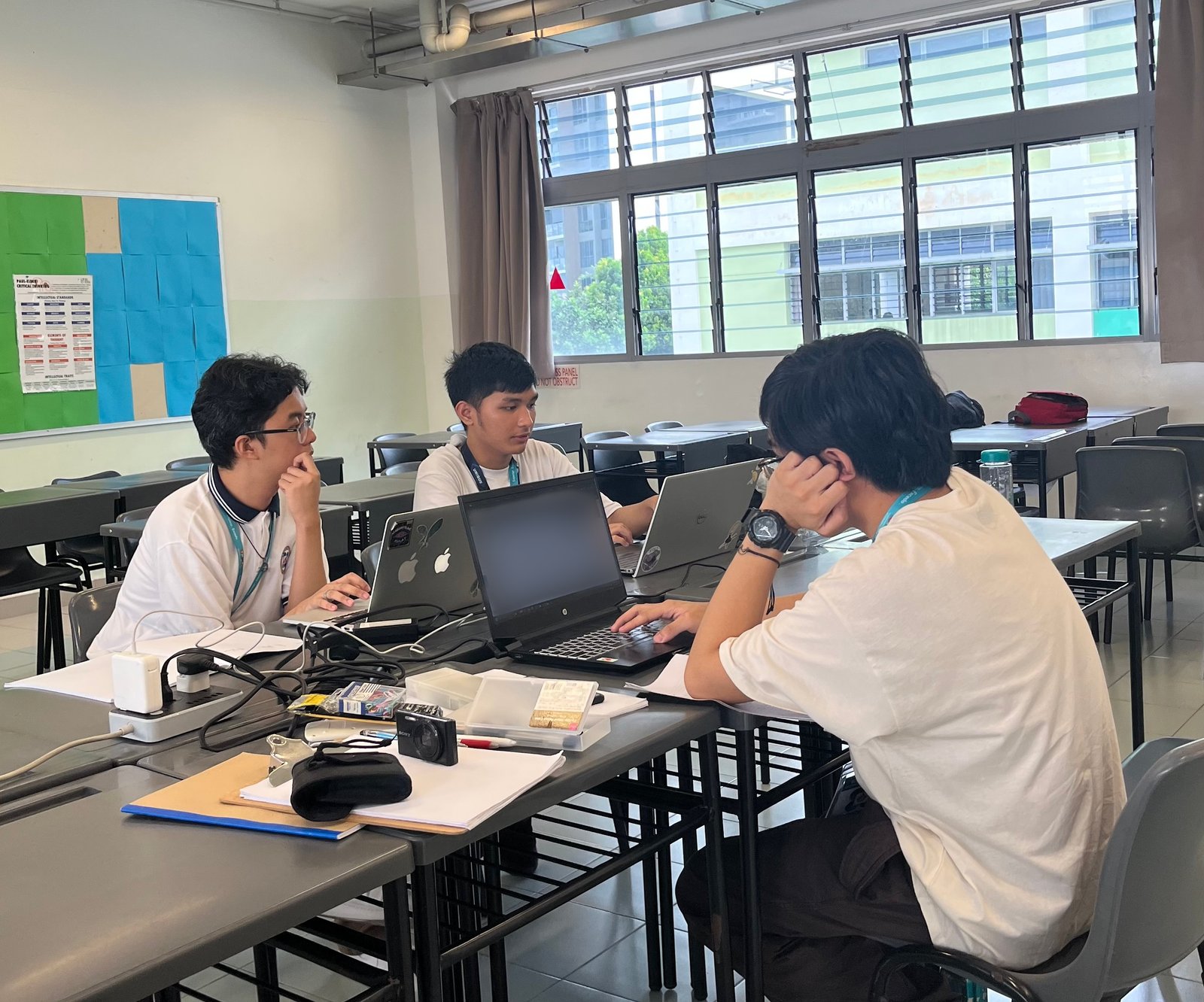
Hope everyone was ready for the official start of the Challenge! Keep in mind what you learnt in the Masterclass by Professor Loh and continue to face the Challenge with a clear head.
You have all worked hard today, so get a good rest! In the meantime, you could learn about what your teachers did today at the Educators’ Learning Festival. We also have an interview with the students from John Monash Science School for you to learn more about other SIMC2.0 participants.
Lastly, don’t be discouraged if you faced difficulties today; there is still time to fine tune and deliver your best work! And remember to trust your teammates — they will always have your back. Lastly, As Professor Leong shared yesterday, “don’t focus so much on winning but focus instead on the process”.
All the best for tomorrow!
Unravelling the 3D Protein Puzzle: SIMC2.0 Challenge 2024
by Lee Pei En and Ng Penn Lun
The moment everyone has been waiting for has arrived – the release of this year’s SIMC2.0 Challenge Question! The 13-page challenge consisting of various parts guides participants to formulate a code and provide a concise explanation for their solution. The crux of the scenario is that fragile single proteins can only be probed once before becoming damaged, so reconstructing a 3D structure of it can only be accomplished via inference from many 2D images. However, the orientation of each protein being unknown makes such a task as difficult as trying to piece a jigsaw puzzle together in a 3D oriented space. With up to 100,000 “pieces” involved in the analysis, the use of machine learning proves the most efficient way to reassemble them.
“I think it’s really cool because there’s a story behind every question, like there’s stuff about proteins, so it’s not just Math.” – Lye Ri-Yen, Year 4 Student, appreciates the interdisciplinary nature of the challenge, which combines concepts from Mathematics, Computer Science, and even Biology.
Though this challenge may seem manageable, even easy to some of the participants, the document filled with densely packed words (and several complex pictures) intimidated some in the Publications team.
“This gives me a revelation – I used to think I was good at Math.” – Zachary Seah, Year 3 Student
“It’s so long.” – Yeap Yew Jin, Year 6 Student
This challenge wasn’t just daunting to the students in the team, as even the teachers were surprised at the difficulty of the problem set, questioning whether a high school student could come up with a solution to all 7 parts in just 30 hours.
“It’ll be crazy if they could solve it.” – Ms Bay Wee Wen, Publications Teacher-in-Charge
As the first few hours of the hackathon fly by, we watch with bated breath as hundreds of participants focus on their code, eyes pinned on computer screens and motivation coursing through their veins. In the words of Andrew Wiles, an English mathematician: “Just because we can’t find a solution, it doesn’t mean there isn’t one”. We wish our participants all the best in solving the challenge and hope this quote will encourage them not to give up!


Green Fact of the Day!
Wow, the Challenge is a whole 13 pages long! Good thing it was released online this year, or we would have used up a lot of paper!
The Buzz about A.I.
by Patricia Adele Tham Yu Jin, Prabakaran Sahana and Kim Yoon Hyun Skylar
For all the educators gathered at SIMC2.0, the Educators’ Learning Festival was a great opportunity to share experiences related to the application of technology in education, particularly that of artificial intelligence (AI). In a world marked by rapid advancements in technology, opportunities to effectively engage students in their education and develop relevant skillsets for the current workforce abound.
A glimpse at the programme booklet of the Learning Festival revealed a wealth of insights waiting to be shared.

The Educators’ Learning Festival opened with a welcome address by Mr Goh Hock Leong, the Deputy Principal of NUS High School. He highlighted the change brought about in our world with the emergence of more advanced artificial intelligence tools. Acknowledging that different school systems respond to the advent of AI differently, he shared his hopes that educators will be able to navigate these tumultuous times and offer students a learning experience that can keep up with the changing times.
Mr Goh then went on to elaborate on NUS High’s own experience of the school’s curriculum being disrupted by the release of ChatGPT in Dec 2022. The first iteration of ChatGPT was able to solve 1 in 4 questions of a Computer Science test accurately. Fast forward to today – the GPT-4.0 released in May was able to solve all 4 questions! The dynamic evolution of AI’s capabilities meant necessitating a change in the assessment tasks, an option that was preferred over trying to strictly police students’ cheating with AI tools.
Clearer guidelines were established on the proper usage of AI such as the use of citations to acknowledge the use of AI, but this is an ongoing journey as AI becomes more advanced. For instance, a popular plagiarism checker called Turnitin is unable to accurately detect AI assistance in students’ work, giving rise to a significant number of false positives or negatives. Mr Goh concluded by underscoring the growing importance of incorporating Information and Communication Technology (ICT) in teaching and learning.

Mr Hardeep Singh Arora from Temus began with sharing about how it is truly an exciting time to be around, with the fourth wave of Artificial Intelligence. Similarly, Ms Juliana Binte Jumain reassured teachers multiple times during her talk that AI would not be replacing them any time soon because of the “human touch” that is so essential to what they do best.

During tea break and lunch, we caught up with some educators to get their take on the Learning Festival…
Mr Vladimir Å ari? from the Mathematical Grammar School in Serbia shared during the tea break that while the talks address nothing unexpected, he gained a deeper understanding about how AI is transforming everything and the measures taken, stating that he is confident about the developments moving forward.
Other teachers shared that they were impressed by the quality of the talks, though different aspects of the sharings caught their attention. Dr Gabriella Blénessy from Fazekas Mihály High School in Budapest noted that she appreciated how Juliana, the second speaker of the day, was able to communicate clearly and effectively, enabling audience members who may not be native speakers of English to understand every word she said; on the other hand, Dr Beth Bumgardner from North Carolina School of Science and Mathematics was fascinated by the AI Centre for Educational Technologies’ approach to learning software, integrating many tools into a single multi-purpose package to suit educators’ every need.

Mrs Asmath Fathima Rizwan from Padma Seshadri Bala Bhavan Senior Secondary School was impressed by the hospitality, saying that it was also a good opportunity to interact with teachers from other countries. She also expressed hopes for more discussion on how to integrate computer science into the teaching of math. She cited the example of how she would love to hear about technologies which change speech to text for mathematical formulae and equations accurately as a more efficient alternative to typing them out.
Like Mrs Asmath, Mrs Ong Hai Ling from Yishun Secondary School was also eager for more! She remarked that she would have liked a hands-on learning experience for SoftMark and the other products introduced.
Certainly, at the back of every teacher’s mind even as they attended these talks was how their students were faring following the release of the SIMC challenge earlier today. As Mrs Asmath aptly put it, “I want my children to complete the challenge. And win!”
Faces of SIMC: John Monash Science School
by Renee Yeap Yew Jin

On Monday, I got the chance to speak to the students from John Monash Science School from Victoria, Australia — Janneke, Joel and Douglas. They kindly donated their precious lunch time to answer my questions, and it was wonderful getting to know them and their school!
“Well,obviously, you are interested in Maths,” I said, “but can you tell me a bit more about your interest?”
What was not obvious to me — although perhaps it should have been given the “Computational” in SIMC2.0 — was that beyond pure maths, they all were well-versed in related fields, such as computer science (CS).
Janneke mentioned that she preferred applied maths to pure maths and that she actually “got interested in maths through physics”, while Joel has been working with computers and technology for a very long time.
They also shared about the computer science they learn at their school. In particular, Janneke and Douglas take a subject called Algorithmics, which teaches the maths behind CS, such as graph theory and algorithmic design.
In NUS High, CS is a mandatory course for Year 1 students — I remember fumbling through the programming tests — and I was curious whether CS was a requirement in their school.
Turns out, the John Monash Science School does have a compulsory data science class in their first year of upper secondary — the equivalent of Year 4 in NUS High — which includes topics like game design and artificial intelligence. I thought game design sounded extremely fascinating and I would definitely take up such an elective if it were offered.
The conversation then moved on to non-STEM related topics.
“How’s the food?” I asked, having seen the last remains of the buffet lunch just a few moments ago.
“Be honest,” their SPL cajoled.
Thankfully, they thought the food was pretty good, especially since it was all for free.
I also asked them if they had any other interests outside of Math and CS and they told me about how they all play instruments, one of them plays tennis and another plays chess.
Janneke and Joel are also involved in their school’s Debating team. As someone also in a language-oriented co-curricular activity — Journalism Club — in a school where the majority is geared towards STEM, I wondered whether it was difficult to generate enthusiasm for debating in their school.
Surprisingly, it appears John Monash Science School has a strong debating culture.
“In Debating, we tend to get more sign-ups than we can handle. We’ve run a couple [of] public debates in the school and we usually get really good attendance. There’s lots of people in the audience, which is great except it’s hard to be heard, so you have to kind of shout,” Janneke shared.
It is heartening that students everywhere have a passion for not just STEM, but the languages and humanities as well. Perhaps one day, we could host a Singapore International Debate and Journalism Challenge…
For now, thank you again to Janneke, Joel and Douglas for sharing with me. Hope you all have a wonderful SIMC2.0!