We shook off the Monday blues and kicked off the first day of SIMC2.0!
Before we dive headfirst into the Challenge which will be released tomorrow, we found our sea legs today by immersing ourselves in an invigorating range of activities.
The SIMC2.0 Opening Ceremony and the launch of the AI Learning Festival set the tone for the week, gearing us up for a week of collaboration, exploration and learning! With all our participants from both the Explore and the Endeavour tracks gathered at the AI Learning Festival, the atmosphere was certainly lively!
Following the Festival, SIMC2.0 Chief Setter, Assistant Professor Loh Ne-Te, gave an insightful Masterclass that prepared our participants for the Challenge ahead. The day ended with a tour of the host school, NUS High School of Math & Science, and ice breakers for everyone to bond and destress.
We hope everyone had a fun day! To our Endeavour track students, get a good night’s rest and bring your best selves to the Challenge tomorrow.
Monday blues? Not when there’s SIMC2.0!
by Lo Ian Ee Eleos and Yeap Yew Jin Renee
Students, in uniforms of all colours and shades, waited in rapt anticipation as the auditorium began to fill up. In unison, they applauded as our distinguished guests, including keynote speaker Associate Professor Ben Leong, Principal of NUS High Ms Soh Lai Leng Magdalen, Chairman of the NUS High Board of Governors Mr Seah Moon Ming, Divisional Director of Curriculum Planning & Development (Division One) with the Ministry of Education, Mr Ong Kong Hong, entered the auditorium.
To start off, Ms Soh welcomed all 362 students and educators from 79 schools to Singapore, thanking NUS High’s long-time partner schools for their continual support. She also highlighted the goal of SIMC2.0 in fostering cross-border collaborative learning in mathematics and computational modelling. SIMC2.0, Ms Soh shared, offers students a platform to creatively explore various solutions to real-world problems. This year, SIMC2.0 has a strengthened emphasis on Artificial Intelligence (AI) to further develop AI literacy amongst participants and to offer educators more insights into the use of AI in education.

Following Ms Soh’s appreciation to the event sponsors Temasek Foundation, Jane Street and Texas Instruments, as well as all who have worked hard to make this event possible, Associate Professor Ben Leong, the Director of the AI Centre for Educational Technologies and the Director of Centre for Computing for Social Good and Philanthropy at NUS School of Computing, delivered his keynote address, where he shared his insights into the development of AI, starting with some of the recent rapid advancements in the field. He cited the example of how AI might have been able to complete 10 out of 30 geometry problems in the International Math Olympiad in its early days. Come today, generative AI like AlphaGeometry scores 25/30 on average, a feat better than the average silver medalist and trailing just behind the average gold medalist!
“I will make a bold prediction. In less than 10 years, AlphaGeometry++ will be able to beat the gold medalist!”
-Assoc Prof Ben Leong

Assoc Prof Leong also discussed fears that AI such as OpenAI’s GPT-4.0 will replace teachers and even jobs that are highly creative. To demonstrate, he played a song by Hong Kong singer “Jacky Cheung”, which everyone enjoyed, but in a shocking twist, he revealed that the music was, in fact, entirely AI-generated with a prompt inspired by his recent concert experience and a nagging from his wife, an admission which drew laughter from the audience.
Assoc Prof Leong shared his hypothesis that with the advent of AI, those who take the easy way out and over-rely on AI will hit a plateau in their skill levels, and will never be able to cross what he coined the “AI Chasm of Death”, endangering their own future job security. He shared a salient bit of advice: “It’s okay to use generative AI, but only if you use it to do the tasks you don’t want to do, not what you cannot do.” He cited the example of how beginner programmers should definitely learn to do the coding themselves. Expert coders however should make use of AI to generate the tedious parts of the code that they are already well-versed in, so that they can free up time to do more higher order work.
He ended his keynote address with a timely reminder to all participants on the importance of collaboration “an instrumental skill in SIMC2.0” and a word of encouragement that “all of you here are selected by your schools to represent them, so you are all winners. Don’t focus so much on winning but focus instead on the process.” Wise words indeed!
A highlight of any SIMC Opening Ceremony is always the interactive segment where the audience are invited to toss and pass several bright multi-coloured cubes from the back of the auditorium to the front of the stage, where four students clad in the letters “S”, “I”, “M” and “C” respectively were eagerly waiting to receive the cubes from the audience. The flurry of excitement culminated in the crowd counting down to the launch of SIMC2.0 2024 as Ms Soh, Mr Seah and Mr Ong collectively pressed and lit a prominent red button (akin to the red dot in the SIMC2.0 logo) to signify the start of SIMC2.0 2024! Let the fun begin!

As the cubes are the crowd favourite, here’s the video on how you can fold your own!

A Festival for Artificial Intelligence
by Tyra Peh and Lye Ri-Yen

Back in March, the 147 students from the Explore track attended a workshop funded by Temasek Foundation, where they learnt the basics of computational thinking and basic skills in AI. Beyond the importance of AI, they were also exposed to the potential limitations and its ethical considerations. After the workshop, they embarked on their own projects to make use of the skills they learnt, culminating in today’s AI Learning Festival.
The AI Learning Festival allowed the participants to showcase their projects, while also giving them the chance to forge new friendships with those who shared similar interests in Mathematics and coding.

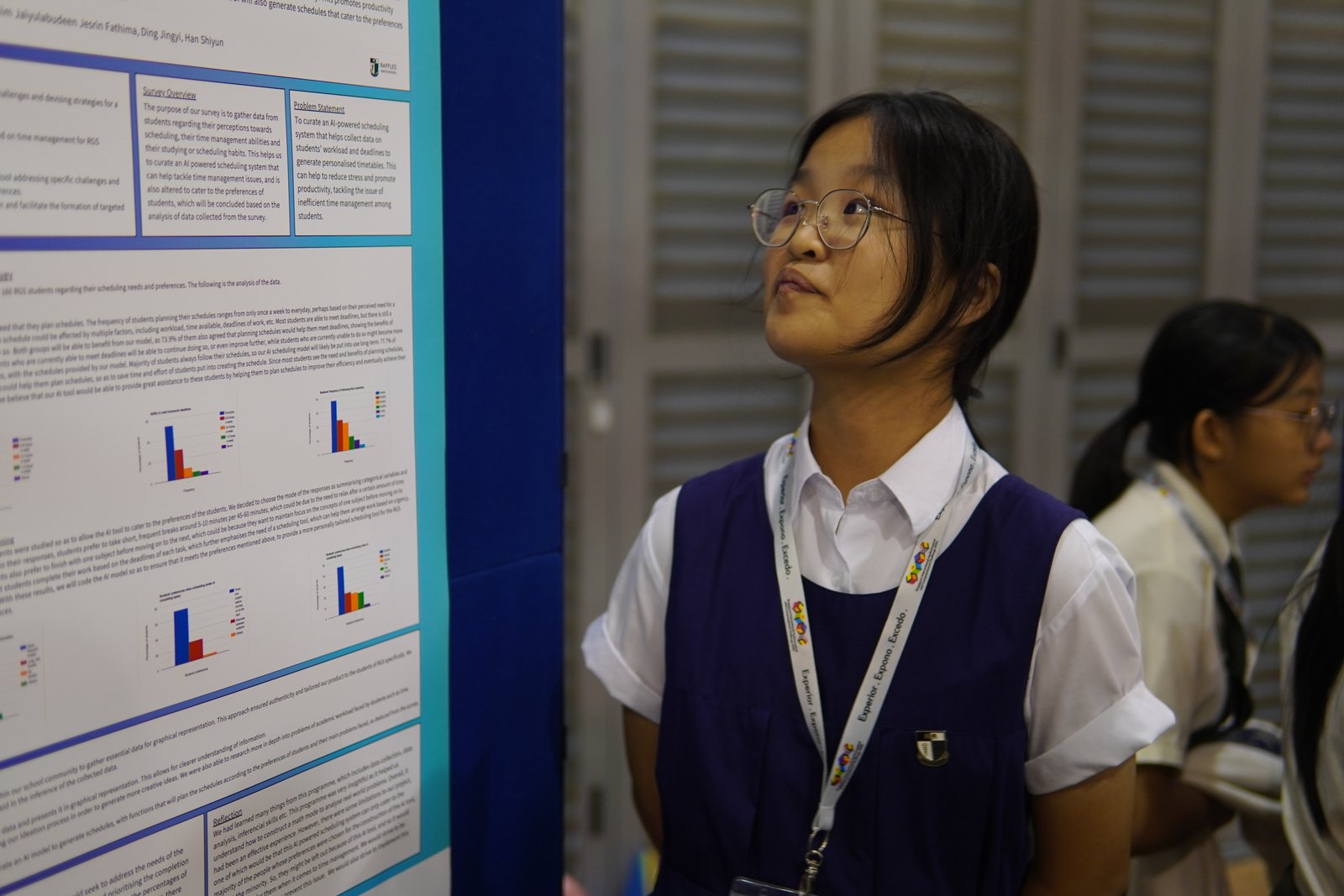
The various takes on using AI to improve our lives were diverse, with projects ranging from increasing students’ productivity to predicting dengue cases in the community.
We spoke to some of the participants, who shared their experiences participating in the Explore track.
A team from Westwood Secondary School did a project on the effects of screen time on one’s Body Mass Index. One of the members, Eric, shared that through the Explore program, his impression of AI changed from being output-centered to having a better appreciation of the collection and processing of data.
The team from Raffles Girls’ Secondary School had a similarly fruitful experience. They shared how they had learnt how to use Orange, a machine learning toolkit, which helped them better analyze their data during the festival. An unexpected gain from the program was the people they met through it. The team members did not know each other previously but managed to “forge new bonds and friendships.”
Another showcase by students from Queensway Secondary School also used Orange, in their case, to help develop a prototype of an AI model that could potentially predict the likelihood of someone needing mental health support. They shared that it was a “very fun learning experience” figuring out how to use Orange.

With the increasing use of AI in the world, what better way to harness its power than by conducting projects to improve our lives and sharing the knowledge we learnt with others?
A Masterclass on How to Catch Cheaters
by Ng Penn Lun and Patricia Tham

Ever heard of “unsupervised classification”? “K-means clustering”? If these terms seem big and scary to you, have no fear, for the Chief Setter Assistant Professor Loh Ne-Te was here to break the concepts down to the Endeavour track participants of SIMC2.0. But before we dive deep into the world of machine learning, let us first look at a problem Prof Loh shared that might require such techniques.
Imagine a simple case: a class of 50 students sits before you, and their results on a recent test are suspicious; you are sure there was at least one group of them cheating. Your task? Find out which of them cheated and who cheated with who. While this sounds simple at first, the numbers quickly balloon the more factors you consider. For instance, you do not know how many cheating groups there are, or how many students there are in each group. In the example he gave with 4 groups of cheaters of unknown size, it would take a thousand supercomputers 1020 years to find and check all possibilities. The universe is a mere 1010 years old – a tiny number in comparison.
Brute force is clearly not an option here. Time to get cracking with some amount of intelligence. By simply inputting the data into Python and letting a machine learning algorithm take the reins, the groups of cheaters can be found in a matter of seconds. All you need to do is merely act as its “supervisor”.

But what made this talk so engaging and a cut above the rest, a true masterclass?
First of all, the lecture covered more than just information on areas like combinatorics or how to code in Python; it was structured in a manner that allowed the audience to immerse themselves in the problem-solving method and techniques used in it, such as through his live coding demonstration. This enabled the audience to glean key information pivotal to solving difficult problems in a short span of time, as well as better appreciate the method to the madness in the complex world of STEM.
Secondly, although the lecture was jam-packed with information, the flurry of facts and figures was made easily accessible and digestible with Prof Loh’s expert knowledge of pedagogy. Some lectures simply bombard you with points to memorise, but not this one. His intimate understanding of the subject shines through in the way he manages to explain complicated concepts to a curious audience.
As the hour of the Challenge draws near, the crucial information provided by Prof Loh may prove itself vital in its unravelling. We wish all competitors good luck and to do their best in SIMC!
Ending Day 1 of SIMC2.0 on a High!
by Ridhi Sulaksh
What awaits participants after an afternoon of serious learning at the AI Learning Festival and a masterclass on computational modelling?
Day 1 of SIMC2.0 ended with a bang! To round off the day, participants were presented with the fun challenge of recreating the SIMC logo out of puzzle pieces, which were earned by participating in ice breaker games such as ‘broken telephone’ and cup stacking.
The games not only allowed the participants to rub shoulders with like-minded peers, but also to make new friends. The vibrant atmosphere of fun and laughter amongst participants from multi-cultural backgrounds was palpable, united by the universal language of math and computing.

For many participants, this was their first overseas flight.
“I felt excited, I felt nervous, I felt scared- mixed emotions,” confessed Pragya, from Budhanilkantha School in Nepal, when asked about how she felt about being in an unfamiliar environment.
As for the Student Programme Liaisons (SPLs), they were filled with a sense of fulfilment seeing everyone come together.
‘Everything comes to fruition this week. Looking forward to seeing more of them interact together, especially on Day 4 and Day 5,” said Xin Kai, a member of the core planning team in charge of logistics
— from meal plans and dietary requirements to coordinating the flight timings of the incoming participants.
After the ice breakers, the students went on a tour of the host school campus to familiarise themselves with the grounds on which they would spend the next few days of the Challenge.

“Your high school is so big, it looks like something straight from a show or a movie!” commented Adish, also from Budhanilkantha School.
We’re grateful for all the compliments! And more importantly, we’re heartened to see Day 1 of SIMC2.0wrap up on a high note. Onward to more adventures ahead!