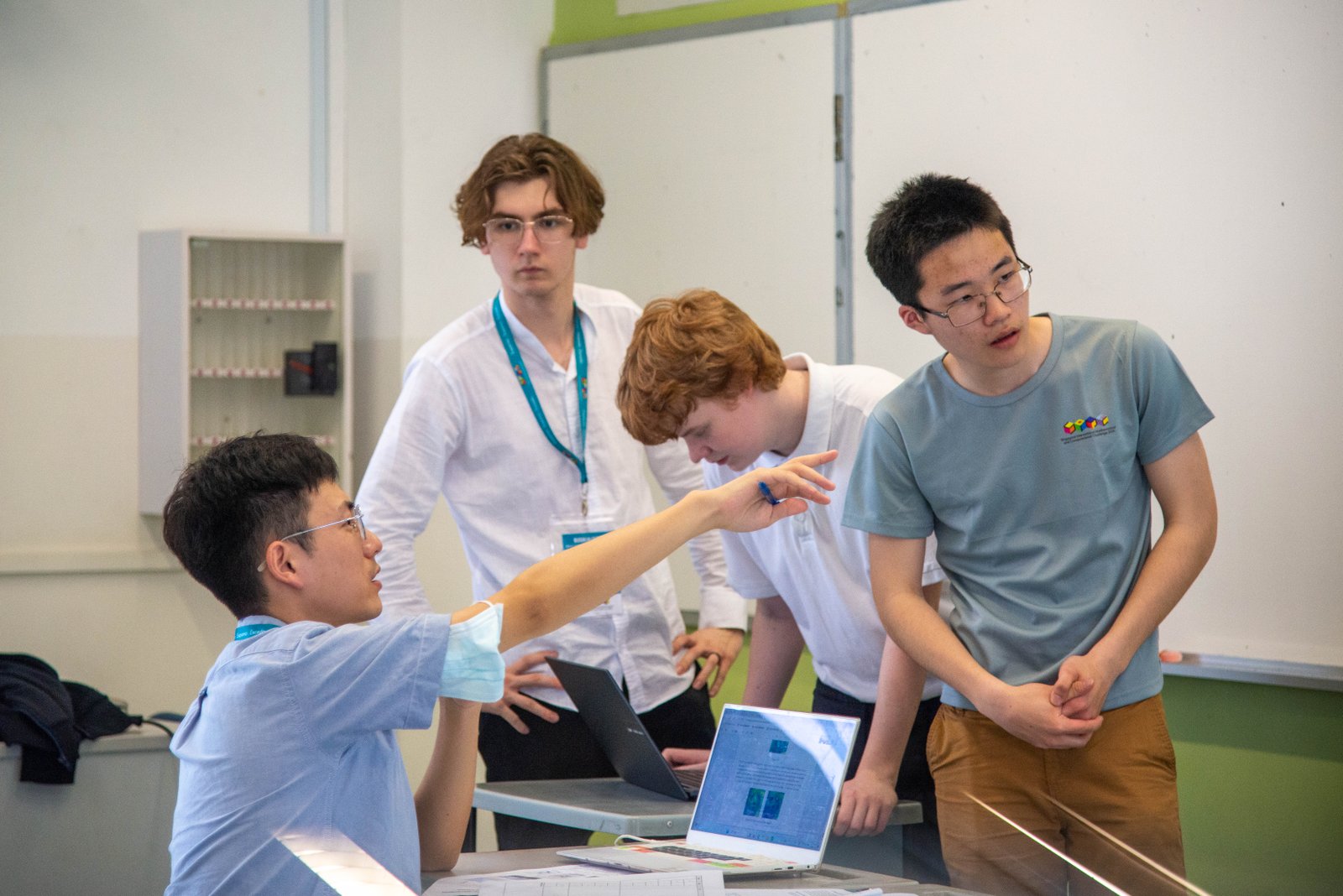
With the written report done, our participants crossed the first hurdle in the Challenge. The past two days of work culminated in today’s oral presentations, where we got to hear everyone present their solutions. We hoped all competitors managed to keep calm and believe in themselves!
After the judging was over, our overseas guests were treated to an evening of touring Singapore! We hope everyone had fun soaking up the exciting scenery and learning more about our local culture. You can read our accounts of the trips to Chinatown and Little India, as well as a reflection on culture and tradition.
Lastly, you also might be interested in reading the interview we did a few days ago with Camborne Science & International Academy, as well as one with our SPLs. Thank you to all the students for speaking to us! 
Students Sprint to the Finish Line in the Presentation Marathon
by Lo Ian Ee, Eleos and Chang Yi Xuan Giselle

Today is the second last day of SIMC2.0! On Tuesday and Wednesday, participants worked to solve the challenge with machine learning and tidied up their report. Today, before they could finally take their well-deserved break, they presented their solution to a host of judges from various institutions around Singapore.

After a whole morning of preparing for the presentations, participants had a quick lunch before going off to their first judging session. Guided by their SPLs to their respective judging rooms, each team presented their solutions to an experienced judge. They briefly introduced the challenge problem before jumping into their methodology. At the end, the judge clarified any questions and graded the team’s solution. The students then hurried off to another room for their next presentation session with another judge. Each team presented a total of three times.
Let us hear how some of the students feel after their last presentation.

Wee Chong from NUS High mentioned that he felt “quite optimistic about the challenge†and that it “had some interesting parts to itâ€.
Another student, Grace, from North Carolina School of Science and Mathematics (NCSSM), thought that it was a “really great opportunity†and “really liked working on the challengesâ€. She was also “glad that it [was] over†as to her, “it [felt] quite stressfulâ€.
Karen from Ritsumeikan High School also stated that “[they] were so nervous to presentâ€, but they thought that overall, it did not go badly.
Catholic High’s Leyang believed that “the presentations were not as nerve-wracking as [he] expected†and “after having three presentations, [he] think[s] [he] got less nervous because [they] had more practice.â€
Some of the students also started thinking about what they wanted to do after the presentation. Alice, also from NCSSM, was “looking forward to the Cultural Learning Journey and … walking around Singapore.†One of the students was even excited to eat the good food from the Cultural Learning Journey.
However, some students felt their performance could have been better. Emily from Eunoia Junior College (EJC) felt that her group was “sometimes … almost at the answer but just stopped thereâ€, without quite arriving at the answer.
In a nutshell, the students seemed to be quite relieved that their presentations were finally over and we hope they take the time tomorrow to relax and enjoy themselves. All the best to both Endeavour and Explore track participants!

Green Fact of the Day!
In previous years, printed booklets were given out, but this year, we have replaced that with an e-booklet containing important information.
As students, how do you try to minimize your paper wastage?
Through the Bustling Streets of Chinatown
by Kim Yoon Hyun Skylar and Lee Pei En
After solving many difficult challenges for SIMC2.0, our participants finally had the chance to let loose on the Cultural Learning Journey around Chinatown. Through this trip, our student volunteers strove to provide participants with a taste of the Singaporean environment and culture, while allowing them to form bonds over these shared memories.
Chinatown, located on the west of the Singapore River, is an area of historical and cultural significance due to being an allocated living area for Chinese immigrants since 1822. This was a transition point for unskilled labourers, coolies, who were made arduous trip to Nanyang (Southeast Asia).
From 5 to 7 pm, the participants were left to freely explore within Chinatown. There were murals artistically depicting our history, such as the Mid-Autumn Festival, Letter Writing, Paper Mask and Puppet Seller, Chinatown Market and Cantonese Opera Wall. Chinatown also features places of worship, such as Jamae (Chulia) Mosque (Masjid Jamae), Sri Mariamman Temple, Buddha Tooth Relic Temple and Thian Hock Keng Temple. Visiting these places allowed the participants to be immersed into and better understand our country’s diverse set of beliefs.

Our participants also had a taste of delicious local food for dinner at the Chinatown Complex Market and Food Centre and Maxwell Food Centre. In asking around for a few opinions, Adish from Nepal’s Budhanilkantha School had especially high praise for the fried pork dumplings, giving it a rating of 9/10. While Laci from Budapest’s Fazekas Mihály High School had many favourites, “chicken rice, char kway teow, fishballs, satay, pork chicken and clam, sugar cane juice and ice kachangâ€!

Although the day’s cloudy weather provided some relief from the sweltering heat for everybody wandering about, it quickly turned to rain from 6:30 pm onwards. This, however, wasn’t enough to dissuade our participants from continuing to browse for souvenirs at the Chinatown Street Market and various shops along the way to their next meetup spot for the following location.
We hope that the participants really enjoyed this event as a meaningful opportunity to experience interesting whole new horizons. May it become an enriching and lasting memory for them!
A Small Glimpse into the World of Little India
by Kew Cheng Feng Timothy

Ever wonder what it feels like to be a tourist in your own city? That was the question on my mind as I followed a group of 3 students and 2 educators from North Carolina School of Science and Mathematics and 2 SPLs through Little India. There is a tangible change in the environment when you first step out of the bus into Little India.
This first street corner is more vibrant in colour than one in a comparatively rural neighbourhood. Indian dance music blasts from a speaker in an electronics shop, boasting about the speaker’s quality to passers-by. We buy tissues from the nearby dollar store and head off to Tekka Centre to get some food. This building, newly refurbished in 2023, doubles as a hawker centre and a clothes market, with food vendors of all cuisines and varieties on the 1st floor and brightly lit corridors crammed with rows and rows of saris, dresses and menswear.
Since it’s situated in Little India, Tekka Centre is different from your average hawker centre, serving a wide variety of Indian cuisine and with obvious influences from other countries adjacent countries, like stalls serving Pakistani cuisine or seeing food with Afghan influence. Stalls here will have interesting charcoal-fired vertical ovens in which they will bake their freshly made naan (Indian bread), a rare sight in Singapore. It was interesting to find drink stalls serving masala tea and ginger tea here as well, as other hawker centres only sell the normal fruit juices or coffeeshop staples like black tea. I found it as testament of Singapore’s multiculturalism also that we came across an Indian Muslim stall selling food with titles translated in Chinese on the sign hanging above their shop.
One student, Everett, said that the food was good and that it was very different from the US, where hawker centres like these don’t exist, and the closest example of a place with different options like this would be a cafeteria in a mall. Other students talked about how beautiful and colourful the dresses and traditional Indian attire were on the second floor. Unfortunately, it was a shame we couldn’t explore the rest of Little India as the rain started pouring while we were eating and didn’t stop, thus we could only explore Tekka Centre before leaving for the next location.
Though we did not manage to see all of Little India, the group was all smiles as we left Tekka Centre, absorbing the sights and sounds of the bustling community in Tekka Centre. Everett said that it was an eye-opening experience for him, as we concluded our little glimpse into the world of Little India.
Tradition and Modernity in Little India and Marina Bay
by Seah Shang-En Zachary
Singapore is a clash of tradition and modernity, of old and new. And nowhere is this divide more prominent than between two famous locations (both of which just so happen to be tourist hotspots), Little India and Marina Bay.
After stepping out of the tour bus and wiping the fog off my glasses, I was welcomed into a scene I hadn’t seen since excursions in Primary 3 — lively, colourful, and overflowing with vibrant culture. This was Little India.
Most of the items I saw being sold were either jewellery or souvenirs. We first went to a souvenir shop, where the Aloisiuskolleg team with us spent a while admiring the souvenirs. The Aloisiuskolleg team ended up buying a few postcards, and then we left to continue checking out the stalls and shops. We later entered a shop where we were welcomed by the scent of dyes and other chemicals. This was a tattoo shop and some of the Aloisiuskolleg team members stopped to get the iconic henna tattoos.
We also visited a temple — decorated with elephants, stone pillars, and a colour scheme far more vibrant than anything we’d seen on the whole of this trip. As some of the Aloisiuskolleg team members went inside to check it out, I started thinking about how despite our multiculturalism and the practice of many religions, religion is not really discussed in Singapore that much. And as religious and cultural practices become less prominent over time, should we fight this decline and preserve our culture, or risk losing our history and identity to modernity? Well, speaking of modernity, it’s time to walk over to Marina Bay, and see the other side of Singapore in all its glory.

The first stop were the Supertrees, and luckily, we rushed there in time for the light show. “Garden Rhapsodyâ€, it was called, and we stood there for around 15 minutes as the lights on the trees flashed as classical music played. After the lightshow ended, we moved over to see another lightshow.
This time, it was held on the water. By spraying the water to create a plane, sort of like a waterfall, but much thinner, light can be projected onto this plane of water, creating a screen out of water. It was really cool, and the Aloisiuskolleg team found it really impressive. There were some really pretty floral patterns, and at one point, there was a dragon flickering across the water screen.
On the topic of culture, the Aloisiuskolleg team decided to try out the staple food of Singaporean youth – bubble tea. So, we made our way to the bubble tea shop, and on the way, I couldn’t help but think again about Singaporean culture. What defines culture? Does it have to be historical? Because compared to an ancient country like Greece or China, Singapore does not have a very long history. Does it have to be original? Because Singapore has such a rojak of cultures, many of which did not originate here. The beloved bubble tea is certainly neither historical nor original in Singapore. So, what defines Singaporean culture? I would say a mix of everything that makes us who we are, regardless of whether it is unique to us or not, and regardless of whether it is modern or traditional. And as we waited for the bubble tea, I realised that today had really been a journey through Singapore.
I can only hope our foreign guests have enjoyed their stay here and appreciated the culture as much as I do. Because be it the countless corridors and rich tapestry of Little India, or the wide bridges and dazzling lights of Marina Bay, all of Singapore is one cultural phen
omenon, and all of Singapore is a place worth visiting.
Faces of SIMC: Camborne Science & International Academy
by Lye Ri-Yen, with help from Tan Le En

The AI Learning Festival was not just a time for students to showcase and share their projects. It was also a platform for us to connect with students from different schools and get to know them more. We talked with students from Camborne Science & International Academy in England, namely Ben, Stanley and Jethro.
While they were all brought together by a shared passion for Math, we were also interested in their personal experiences, from the flight to Singapore to the activities they had participated in. When we asked them about some culture shocks they had when first arriving in Singapore, it came as no surprise that their answer was “the weatherâ€. Even as a local, the hot and humid temperatures have never been something I was used to, so it was understandable students coming from a “temperate climate†would feel a drastic change.
On that relatable note, the conversation moved to another topic: “What part of Singapore are you most excited to see?†Seeking a non-local’s impression of Singapore, I was quite surprised to hear that the students were especially interested in seeing the cityscape of Singapore, as they don’t see much of it at home. Singapore has long since been described as a thriving “Garden Cityâ€, with the UNESCO heritage nature site of the Botanic Gardens, so I was astonished by their appreciation of our cityscape and architecture!
Tying everything back to the present event, I asked them what the highlight of SIMC2.0 had been so far. They enjoyed the opening ceremony the most, as it was made interactive with the origami cubes and felt like “much effort was put into the preparationâ€.
Lastly, though their schedule was filled with many other activities like cultural tours around Singapore, the students were most excited about the challenge segment to see how far they could push themselves while solving it.
With the challenge released (in its 13-page glory), we would like to thank Ben, Stanley and Jethro for sharing their experiences with us. We wish them and all participants the best of luck as they tackle the challenge!
“I’m Afraid to do Maths homeworkâ€: Honest Reflections from our SPLs
by Renee Yeap Yew Jin
Ferrying our participants around, making sure they have all they need, as well as sharing with them all about Singapore and NUS High — our Student Programme Liaisons, called SPLs for short, are a vital pillar of SIMC2.0.
I interviewed a few of my friends who have taken on the SPL role, and I hope their insights will prove valuable to future aspiring SPLs, or, at the very least, provide an entertaining read.
Is there anything you did to prepare for your role as SPL?
“All of us had to go for briefings and dry runs over 2 days prior to SIMC2.0, where we tried out the activities planned to get a feel for it, and this included exploring the places for the Cultural Learning Journey. After these 2 days, I also had to… make a trip to Marina Bay Sands and Gardens by the Bay to better familiarise myself with the surroundings.†— Alex, SPL for Alferov Physical Technical High School
Niranjana, an SPL for Padma Seshadri Bala Bhavan Senior Secondary School, mentioned that many SPLs will also read up online about the schools and countries they are assigned to, especially if they are not too familiar with them.
But for Niranjana, her parents also come from Chennai, India, where the school is located.
“I go back there every year, so I already had some background information when preparing.†— Niranjana
My fellow Journalism Club member Sze Yin also shared her experience preparing to be an SPL for The High School Affiliated to Xi’an Jiaotong University.
“Initially, I was a bit apprehensive due to the seriousness that came with being a representative of our school. I was worried that we would struggle with language barriers… [so] I tried to speak more and brush up on my Mandarin since I wanted to be able to speak more fluently and communicate better with them!†— Sze Yin

The language barrier is certainly something to be concerned about — I had to stop myself from unintentionally speaking in Singlish when interviewing some overseas participants — so it is important for SPLs to make sure that there is no miscommunication!
What are you looking forward to this week?
“The Cultural Learning Journey. That’s the actual time I’ll be spending with them, telling them about our culture and history, like our multiracial and multicultural society.†— Niranjana
“I’m looking forward to interacting with people from different regions and learning more about their cultures, lives and experiences. It’s rare to participate in an international event like SIMC2.0, so I am definitely going to treasure the chance to have fun and make new friends with new people.†— Alex
I also spoke to Yiying, the SPL for John Monash Science School. I found out that the SPLs have different roles and schedules, meaning that not all SPLs will attend the same events. Yiying told me that she originally wanted to “SIMC maxâ€, as in max out her SIMC2.0 experience by attending all the events, so she was a bit disappointed at first that she was not allocated to some of the upcoming events this week.
“But eventually I came to realise that I don’t need to be too sad if I’m not assigned to certain activities, because overall I still had a good time.†— Yiying
I thought that was a particularly important insight as I too had imagined the SPL role offered the privilege of attending all the fun events. Ultimately, our roles were planned out based on what was necessary to allow SIMC2.0 to run smoothly, not to satisfy our personal wishes. So, Yiying is right — we must make the most of it!
BONUS: Here is a funny bonus quote that I could not leave out!
“I’m afraid to do Maths homework around them, because I’m afraid they’ll judge my level of maths.†– anonymous SPL who is already taking Year 6 Mathematics